Abstract
Climate change negatively affects the production systems and producer’s incomes. This study assesses the impact of Village Savings and Loan Associations (VSLA) on strengthening the resilience of vulnerable populations to climate change. Data were collected through focus groups with 41 VSLA and a survey of 210 households VSLA members and non-members, using Holistic Self-Assessment of Peasant Resilience tool. Analysis of variance was applied to the data. The Newman-Keuls test at 5% threshold was used to compare resilience scores, and the chi-square test was applied. The number of VSLA is increasing in Central West region of Burkina Faso. The VSLA of first generation mobilized a yearly average of 1 522 401 F CFA and gave 895 941 F CFA of credits. Their main strengths are solidarity, social cohesion, collect of savings and credit access. VSLA members showed significantly higher resilience scores across social, economic, and environmental domains, particularly in income diversification (p<0.01), land management (p<0.001), and reforestation practices (p<0.001). VSLA contributes significantly to improve social, economic and environmental resilience scores for the vulnerable communities. For the successful operation of VSLA, it’s important to establish partnerships with financial institutions to promote financial inclusion and strengthen actors capacities for more impacts.
Keywords
Association, Burkina Faso, Climate Change, Resilience Score, Savings
1. Introduction
Climate change has caused widespread adverse impacts and related losses and damages to nature and people that are unequally distributed across systems, regions and sectors. Economic damages from climate change have been detected in climate-exposed sectors, such as agriculture, forestry, fishery, energy, and tourism. Individual livelihoods have been affected through, for instance, destruction of homes and infrastructure, and loss of property and income, human health and food security, with adverse effects on gender and social equity. Global surface temperature has increased faster since 1970 than in any other 50-year period over at least the last 2000 years
| [1] | IPCC. Climate Change: Synthesis Report. Contribution of Working Groups I, II and III to the Sixth Assessment Report of the Intergovernmental Panel on Climate Change [Core Writing Team, H. Lee and J. Romero (eds.)]. IPCC, 2023, Geneva, Switzerland, 184 pp.,
https://doi.org/10.59327/IPCC/AR6-9789291691647 |
[1]
. Climatologists predict a 7.3% decrease of rainfall by 2050, increased floods, more frequent drought spells, strong winds and 1.7°C increase of temperatures by 2050
| [2] | Roncoli C, Ingram K, Kirshen P. «the costs and risks of coping with drought: livelihood impact and farmers’ responses in Burkina Faso», In Climate research, 19, 2001, pp. 119-132. |
| [3] | Brou Y T., Akindes F., Bigot S. «Climate variability in Côte d'Ivoire: social perceptions and agricultural responses», In Cahiers Agricultures. 2005, 14(6): 533-540.
https://doi.org/10.13140/2.1.5174.3368 |
[2, 3]
. The Paris Agreement, adopted on December 12, 2015 at COP 21 (United Nations Climate Change Conference) by world leaders, aims to limit global warming to 1.5°C by the end of this century.
Increasing weather and climate extreme events have exposed millions of people to acute food insecurity and reduced water security, with the largest adverse impacts observed in many locations and/or communities in Africa. Approximately 3.3 to 3.6 billion people live in contexts that are highly vulnerable to climate change
| [1] | IPCC. Climate Change: Synthesis Report. Contribution of Working Groups I, II and III to the Sixth Assessment Report of the Intergovernmental Panel on Climate Change [Core Writing Team, H. Lee and J. Romero (eds.)]. IPCC, 2023, Geneva, Switzerland, 184 pp.,
https://doi.org/10.59327/IPCC/AR6-9789291691647 |
[1]
.
Burkina Faso's economic and social development is based on agriculture, which is primarily rain-fed. The primary sector contributed for 16.3% to the country's gross domestic product (GDP), despite the country's security crisis
| [4] | Ministry of Economy, Finance and Forecasting (MEFP). National accounts for 2023 (First estimates based on the CNTs), 2023, 11 p. |
[4]
. It employs more than 80% of the working population
| [5] | PNSR II. Second National Rural Sector Programme (PNSR), 2017, 70 p. |
[5]
. Constraints on agriculture include climatic hazards and difficulties in accessing financing. Indeed, the country has experienced a series of climate-related disasters
. The major droughts of 1972 and 1984 destroyed fodder and crop resources, dried up rivers, decimated livestock, and caused famine
| [7] | Sidibe H, Diallo M et Barry C. «Pulaaku and identity crisis: the case of the Red Fulani of the Issa-Ber lake region in Mali» In Fulani identity; Paris, Karthala, 1997, pp. 223-240. |
[7]
. More recently, on September 1, 2009, torrential rain caused a flood that resulted in nine (09) human losses in the city of Ouagadougou alone, 150,000 people affected, the destruction of 250 homes and around ten bridges
.
Rainfall is marked by strong intra-annual and spatio-temporal variability with rainfall decreasing from south to north
| [9] | National Meteorological Agency (ANAM-BF). Ten-day agro-meteorological bulletin n 28, 2022, 11 p. |
[9]
.
The heavy reliance of rural economies and populations on rain-fed agriculture leads to a decline in agricultural production and demonstrates the growing vulnerability of the rural sector to climate change. Consequently, the country's level of development remains low with a Human Development Index (HDI) of 0.438
| [10] | United Nations Development Programme (UNDP). Human Development Report, 2022, 8 p. |
[10]
. The percentage of the Burkinabe population living below the poverty line increased from 41.4 to 43.2% between 2018 and 2021
| [11] | Ministry of the Economy, Finance and Forecasting (MEFF). Main findings of the study on poverty and household living conditions, 2021, 8 p. |
[11]
. The low income of populations, particularly in rural communities, make access to credit difficult in financial institutions. Besides the guarantees that are required by financial institutions, the cost of credit is also high
| [12] | National Institute of Statistics and Demography (NISD). Multi-sectoral survey: Savings and access to credit, 2015, 73 p. |
[12]
. In addition, some financial products are not always adapted to the needs of farmers.
Inaccessibility to financing makes producers more vulnerable to climate shocks. To improve access to financing and, in turn, the resilience of vulnerable populations, local savings and credit management mechanisms, including village savings and credit associations (VSLAs) which is one of the pillars of the Resilience Fund (CdR) approach, have been promoted by rural development stakeholders. VSLAs are associations made up of groups of 15 to 30 people who voluntarily come together, save together, and periodically take out small loans from their savings. VSLAs are intended for poor populations with irregular incomes, which represent a high risk for microfinance institutions. They offer to their members low-cost financial services based on the principle of pooling funds
| [13] | CARE. Micro-savings: a development tool for populations excluded from microfinance., 2013, 13 p. |
[13]
. They are governed by ten fundamental principles
| [14] | Kaire A.K., Sow S. et Balde S. The effects of microcredit on strengthening the socioeconomic power of women members of the Village Savings and Credit Associations (VSLAs) of the Commune of Sahm Notary. Int. J. Econ. Stud. Manag. 2022, 2, No. 3. 473-488 https://doi.org/10.5281/zenodo.6913827. |
[14]
which are: autonomy, limited and self-selected members, voluntary membership, number of shares purchased limited to 5 per meeting, granting of credit, solidarity fund, regular meeting, transaction during meetings, existence of individual account books, cycle duration between 9 and 12 months.
Several research studies have focused on the contribution of VSLAs to strengthening the socio-economic power of women members in Senegal; in the Democratic Republic of Congo and in Benin
| [14] | Kaire A.K., Sow S. et Balde S. The effects of microcredit on strengthening the socioeconomic power of women members of the Village Savings and Credit Associations (VSLAs) of the Commune of Sahm Notary. Int. J. Econ. Stud. Manag. 2022, 2, No. 3. 473-488 https://doi.org/10.5281/zenodo.6913827. |
| [15] | Eclosio. Village Savings and Credit Associations (VSLAs): A tool for strengthening the economic empowerment of Beninese women farmers. ANAF-Benin, 2016, 3 p. |
[14, 15]
. Other authors have worked on the role of VSLAs in improving the living conditions of populations, their functioning and dynamics of solidarity and their contribution to entrepreneurship in rural areas in Benin, Burundi, Cameroon, Ivory Coast and Chad
| [13] | CARE. Micro-savings: a development tool for populations excluded from microfinance., 2013, 13 p. |
| [14] | Kaire A.K., Sow S. et Balde S. The effects of microcredit on strengthening the socioeconomic power of women members of the Village Savings and Credit Associations (VSLAs) of the Commune of Sahm Notary. Int. J. Econ. Stud. Manag. 2022, 2, No. 3. 473-488 https://doi.org/10.5281/zenodo.6913827. |
| [15] | Eclosio. Village Savings and Credit Associations (VSLAs): A tool for strengthening the economic empowerment of Beninese women farmers. ANAF-Benin, 2016, 3 p. |
| [16] | Ndabarushimana A. & Niyokwizzera E. Role of Save Our Souls (SOS) Children's Villages Burundi in the Community Development Process: The Case of Village Savings and Loan Associations (VSLAs) Initiated by its Program for Improving the Living Conditions of Households in Bujumbura. ESI Preprints, 2022, 339 p. https://doi.org/10.19044/esipreprint.10.2022 |
| [17] | Fall K. Organization and Dynamics of Solidarity in Rural Areas: The Example of Village Savings and Credit Associations (VSLAs), Scientific Journal of the Alassane Ouattara University. 2021. Vol. 1 -. 40 p. |
| [18] | Champchesnel M. F., Fioekou C., Sanda H B., Lavaur A-L, Mayans J. Village Savings and Credit Associations: an approach adapted to the poorest households? Characteristics of members and impact on household economies. Clichy France, 2016, 36 p. |
[13-18]
. Studying the dimension of climate resilience is an essential and logical next step because there is a lack of empirical data on the contribution of Village Savings and Loan Associations (VSLAs) in the different areas of resilience. In this study, resilience is operationalized as the ability of a system to recover, reorganize, and evolve after experiencing external stresses and disturbances
| [19] | Choptiany J., Graub B., Phillips S., Colozza D. & Dixon J. Self-evaluation and holistic assessment of climate resilience of farmers and pastoralists. Rome, FAO, 2015.
http://www.fao.org/3/i4495e/i4495e.pdf (accessed 20 October 2025). |
[19]
. Very little work has focused on the impact of VSLAs on improving the resilience of vulnerable populations in Burkina Faso, hence the interest of this study.
In Burkina Faso, the first VSLAs were installed in 2016 by the Food and Agriculture Organization of the United Nations (FAO) as part of the OSRO/RAF/605/BEL project and the GCP/BKF-054-LDF project, funded respectively by the Belgian Cooperation and the Global Environment Facility (GEF). The GEF project, which lasted 5 years (2016-2020), aimed to develop good resilient agricultural practices and financing opportunities for rural people. As part of this project, 153 VSLAs were established in four regions (Central west, Central-North, North and Sahel), including 43 in the Central-west region. The overall objective of this study is to assess the impact of VSLAs on strengthening the resilience of vulnerable populations to climate change in the Central-West region. Specifically, this involved: (i) taking inventory of VSLAs in the Central-West region, (ii) analyzing the functioning of VSLAs in the Central-West region and (iii) evaluating the contribution of VSLAs in improving the resilience of vulnerable populations in the face of climate change. The hypotheses of our research are as follows: (H1) the number of Village Savings and Loan Associations (VSLAs) increased after the GEF project in the Centre-West region; (H2) first-generation VSLAs adhere to operating rules better than second-generation VSLAs; and (H3) the climate change resilience scores of VSLA members are higher than those of non-VSLA members.
2. Material and Methods
2.1. Presentation of the Study Area
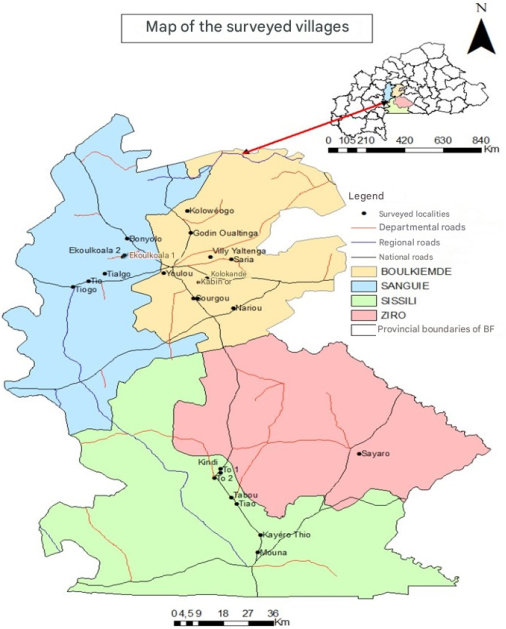
The study was conducted in the Central-West region (
Figure 1). The choice of this region was motivated by a relatively calm security context, the continuation of VLSA activities and their accessibility. With an area of 21,853 km
2 and a population of 1,660,135 inhabitants
| [20] | RGPH. Monograph of the Central-Western Region, 2019, 181 p. |
[20]
, it is located between latitudes 11° and 13° North and longitudes 1°30 and 3° West. The relief is generally not very hilly, but does include elevations of varying altitudes. The main types of soil encountered are sandy-clayey, ferruginous, thick and loose ferralitic
| [21] | Central West Regional Development Plan, 2017-2021, 2017, 169 p. |
[21]
.
The climate is North Sudanese and South Sudanese. Rainfall is irregular and unevenly distributed throughout the region. Three types of vegetation characterize the region: shrub savannahs, wooded savannahs, and gallery forests. The region has six classified forests with a total area of 145,549 ha and more than fifty conservation areas with a total area of nearly 5,000 ha
| [21] | Central West Regional Development Plan, 2017-2021, 2017, 169 p. |
[21]
. Agro-pastoral activities, crafts, and trade occupy a very important place in the region's economy. Climatic variations constitute a constraint on the proper development of agro-sylvo-pastoral activities.
Figure 1. Location of the study area.
2.2. Methodology
2.2.1. Sampling
Technical services, non-governmental organizations (NGOs), United Nations agencies (UN), and projects and programs were selected using a snowball method until saturation was reached to understand more about the strengths, weaknesses, opportunities and threats of VSLAs. In addition a total of 41 functional VSLAs, including 24 first-generation VSLAs (established by the GEF project) and 17 second-generation VSLAs (established by the GEF project's VSLAs), were purposefully selected for the focus groups. The main selection criteria were the availability of members and the village's accessibility.
Moreover to the focus groups and interview with development stakeholders, 210 heads of household, including 105 VSLAs members and 105 non-VSLA members, were surveyed. The 105 VSLAs members were selected from 35 VSLAs, including 24 first-generation VSLAs and 11 second-generation VSLAs. In each of the 35 VSLAs, 3 voluntary and available members were randomly selected from 35 villages where VSLAs are located, i.e., the 105. Three other heads of household, non-VSLA members and available in each of the villages where VSLAs were located, were also randomly selected. The sample size has been limited to 210 based on feasibility and accessibility.
2.2.2. Data Collection
In addition to the literature review, data were collected in two complementary phases, one qualitative and the other quantitative. An individual interview guide, a focus group interview guide and the survey questionnaire of the Holistic Scheme for Self-Assessment of Farmers (SHARP) of Climate Resilience were used on Open Data Kit Collect (ODK Collect). It was organized into three main steps:
1) Step 1: An individual interview guide was administered to resource persons in technical services, non-governmental organizations, United Nations System Agencies, projects and programs. These interviews made it possible to know the exhaustive number of VLSAs implemented, their strengths, weaknesses, threats and opportunities.
2) Step 2: On the day of the meeting of each of the 41 VSLAs, we monitored the animation to assess compliance with the animation rules. After the meeting, a focus group was conducted with the five members of the VSLAs management committee (President, Secretary, Treasurer, and 2 Counters) and the three members holding keys to the fund. The strengths, weaknesses, opportunities and threats were identified and the degree of satisfaction of the members assessed. A review of the VSLAs documentation (books, registers, internal regulations) was carried out to collect the number of shares, members, the amounts of the shares, the solidarity fund, etc. These variables were used to calculate the amounts mobilized and credits granted to the members.
3) Step 3: The SHARP tool survey questionnaire was administered face-to-face to the 210 heads of household who were members and non-members of VSLAs. This survey collected data on socio-economic characteristics, agro-sylvo-pastoral production activities and practices, access to production factors, markets, financial services, insurance, organization, household economy and government policies and programs on climate change. These data were used to calculate the climate resilience scores of households who were members and non-members of VSLAs.
2.2.3. Method of Analysis
Descriptive statistics were applied to the focus group data and individual interviews to construct figures on the number of VSLAs established in the Central-West region and the strengths, weaknesses, opportunities and threats of VSLAs. To compare the quality of VSLAs functioning according to generations and the resilience scores of members belonging to VSLAs groups and members not belonging to VSLAs groups, an analysis of variance (ANOVA) was performed on the focus group data and household surveys. The Newman and Keuls test was used to make the comparison at 5% threshold of quantitative data and the χ2 test for the analysis of contingency tables. The analysis of variance (ANOVA) and statistical tests were carried out with XLSTAT, 2024 software.
(i). Theoretical Framework for Resilience Analysis
Several tools are used in the analysis of resilience to climate change. These are CoBRA (Community Resilience Assessment and Action); REAL (Resilience Evaluation, Analysis and Learning), RIMA (Resilience Index Measurement and Analysis), SHARP (Holistic Scheme for Peasant Self-Assessment of Climate Resilience)
| [22] | Coordination Sud. Adaptation and resilience to climate change: Review of metrics and monitoring indicators, 2022, 43 p. |
[22]
. As part of our study, we used the SHARP + tool. It was developed by FAO to meet the needs of small farmers and pastoralists to assess their resilience to climate change at the household and community level through a holistic, integrated, inclusive and scientifically based approach
| [23] | Lagana H, M., Phillips, S. and Poisot, A. Self-evaluation and holistic assessment of climate resilience of farmers and pastoralists (sharp+) – A new guidance document for practitioners. Rome, FAO. 2022.
https://doi.org/10.4060/cb7399en |
[23]
. It explores farmers' perceptions, behaviors and priorities to improve their resilience and food security
| [23] | Lagana H, M., Phillips, S. and Poisot, A. Self-evaluation and holistic assessment of climate resilience of farmers and pastoralists (sharp+) – A new guidance document for practitioners. Rome, FAO. 2022.
https://doi.org/10.4060/cb7399en |
[23]
. It defines resilience as the ability of a system to recover, reorganize, and evolve after experiencing external stresses and disturbances
| [19] | Choptiany J., Graub B., Phillips S., Colozza D. & Dixon J. Self-evaluation and holistic assessment of climate resilience of farmers and pastoralists. Rome, FAO, 2015.
http://www.fao.org/3/i4495e/i4495e.pdf (accessed 20 October 2025). |
[19]
. This definition, given by SHARP+, is inspired by that of several authors
. It is based on the 13 indicators of resilience of agroecosystems
and is composed of 5 domains and 33 modules codified
| [19] | Choptiany J., Graub B., Phillips S., Colozza D. & Dixon J. Self-evaluation and holistic assessment of climate resilience of farmers and pastoralists. Rome, FAO, 2015.
http://www.fao.org/3/i4495e/i4495e.pdf (accessed 20 October 2025). |
[19]
.
Table 1 presents some examples for coding. The tool generates a score from 0-20 for each resilience component, with higher scores indicating greater resilience (
Table 2).
Table 1. Schematic representation of the SHARP coding system.
Domains | Modules | Componentes |
Name | Prefix | Noon | Label | Technical score | Self-assessed adequacy | Self-rated importance |
Social | SO | Household | hh | SO-hh-ac-average | SO-hh-adq | SO-hh-imp |
Agronomique | AG | Agricultural practices | agr | AG-agr-ac-average | AG-agr-adq | AG-agr-imp |
Environment | EN | Tree management practices | trees | EN-trees-ac-average | EN-trees-adq | EN-trees-imp |
Economic | EC | Income, expenses and savings | inc | EC-inc-ac- average | EC-inc-adq | EC-inc-imp |
Institutionnal | GO | Policies and programs on climate change | gov | GO-gov-ac- average | GO-gov- adq | GO-gov- imp |
(ii). Resilience Score Calculation
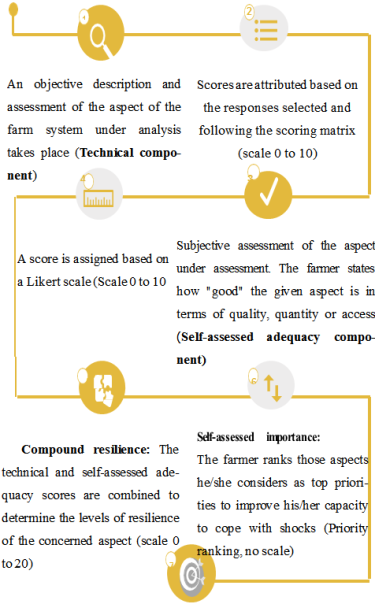
The overall resilience score, ranging from 0 to 20, is the sum of the technical score (maximum 10 points) and the self-assessed adequacy score (maximum 10 points). Households with low resilience scores will score close to 0 (
Figure 2). The self-assessed importance component highlights the areas that respondents consider essential to improve their household's resilience, increase its capacity to cope with unforeseen stresses, and strengthen its livelihoods.
(iii). Calculations on VSLAs
(1)
(2)
(3)
(4)
Table 2. Resilience thresholds used to determine resilience performance.
Resilience thresholds | Scale | Signification |
Low level of resilience | 0 -7 points | Households have limited capacity to cope with problems in agricultural systems |
Medium level of resilience | 7.01-12 points | Aware of the problems but only partially addressed due to limited or inadequate information, know-how, resources, etc. |
High level of resilience | 12.01-20 points | Problems identified and addressed quickly |
3. Results
3.1. VSLAs Implemented in the Center-west
In the Central West region, VSLAs were established as part of the projects and programs of the following organizations:
Association Formation Développement Ruralité / Training, Development, Rurality Association (AFDR),
Action pour l’Education et le Développement Durable / Action for Education and Sustainable Development (AEDD),
Association des Mains Unies / United Hands Association (AMUS), Association Songi Malgre-Aide au Développement Endogène / Aid for Endogenous Development Association (ASMAD),
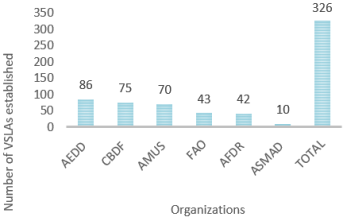
Coalition Burkinabè Droit de la Femme / Burkina Women Right Coalition (CBDF) and FAO. As of September 2024, 326 VSLAs have been established in the Central West from 2016 to 2024 (
Figure 3). All of these VSLAs mobilize savings at the local level and grant credits to their members for income-generating activities.
Figure 3. Village savings and credit associations established by organizations in the Central-West region.
3.2. Strengths, Weaknesses, Opportunities and Threats of VSLAs According to the Actors
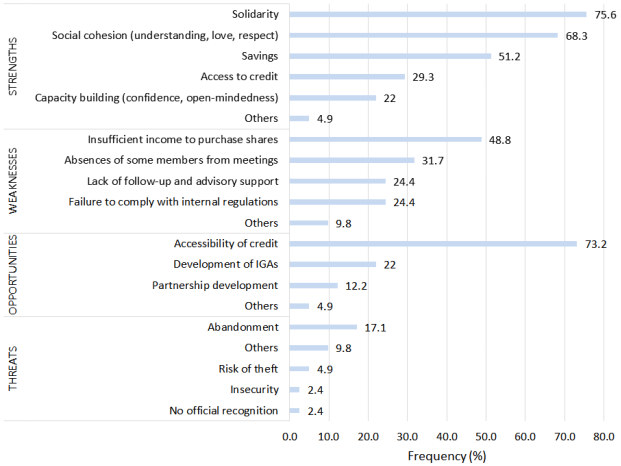
The main strengths of VSLAs are solidarity (75.6%), social cohesion (68.3%), savings (51.2%) and access to credit (29.3%) (
Figure 4). In terms of weaknesses, we mainly note insufficient income to purchase shares (48.8%), the absence of certain members at meetings (31.7%), non-compliance with internal regulations (24.4%) and the lack of monitoring and advisory support (24.4%). However, VSLAs offer opportunities for access to credit (73.2%) and the development of income-generating activities (22%) in rural areas. The main threat to the sustainability of VSLAs remains member abandonment (17.1%) if the VSLA methodology is not well mastered, the risk of theft (2.4%) and insecurity (2.4%).
Figure 4. Strengths, weaknesses, opportunities and threats of VLSAs according to members.
3.3. Socio-economic Characteristics of VLSAs According to Generation
With an average share of 345 CFA francs for the first VLSAs generation and 273 CFA francs for the second VLSAs generation, the VLSAs mobilized respectively 1,522,401 and 1,338,156 CFA francs per cycle. The variables: number of completed cycles, average number of men who dropped out per completed cycle and average amount of credits granted to men per completed cycle are those where the differences are statistically significant (
Table 3). Indeed, the average number of completed cycles of the first VLSAs generation is higher (5a ± 1) than that of the second VLSAs generation (3b ± 1). This difference is significant (F = 49.475; p < 0.001). This could be explained by the fact that the first VLSAs generation were initially installed and carried out to completion. They would have had the opportunity to complete several cycles compared to the second VLSAs generation.
The average number of men who dropped out per completed cycle in first-generation of VLSAs (1a ± 1) significantly exceeds that of second-generation of VLSAs. (0b; F = 6.041, p < 0.05). The average amount of credit granted to men per completed cycle is 206,818 a ± 23.519 CFA francs for first-generation of VLSAs. and 47.526 b ± 11.422 CFA francs for second-generation VLSAs. This difference is significant (F = 6.304; p < 0.05).
Table 3. Average socio-economic characteristics of VLSAs according to generations for completed cycles.
Variables | First generation | Second generation | F | P-value |
Number of cycles completed | 5a ±1 | 3b ± 1 | 49.475 | *** |
Average number of members | 28a ±6 | 26a ± 7 | 1.102 | - |
Average number of abandoned men | 1 a ±1 | 0b | 6.041 | * |
Average share value (FCFA) | 273 a ± 113 | 345 a ± 131 | 3.514 | - |
Average share amount (FCFA) | 1 212 862a ±763 672 | 1 308 731a ±620 073 | 0,157 | - |
Average total amount of solidarity at closing (FCFA) | 79330 a ± 48 044 | 54 355 a ± 49 880 | 2.606 | - |
Average amount of men's credits (FCFA) | 206818 a ± 23519 | 47 526 b ± 11 422 | 6.304 | * |
Average amount of credits for women (FCFA) | 693290 a ±143105 | 400 508a ± 68 293 | 0.578 | - |
Average amount of member credits (FCFA) | 895 941a ± 139 940 | 521523a ± 76307 | 0.951 | - |
Average amount mobilized (FCFA) | 1 522 401 a ±1 238 515 | 1338156 a ±494 515 | 0.318 | - |
Average amount total received per member (FCFA) | 51 882 a ±43 359 | 45 115a ±25 512 | 0.094 | - |
- not significant; * < 0.05; **: p < 0,01; ***: p < 0,001
3.4. Operation of VLSAs
First-generation VSLAs demonstrated more stable operations and greater financial volume than second-generation groups (
Table 4). The operation of Village Savings and Loan Associations (VSLAs) is governed by rules summarized in internal regulations approved by the members. Generally, both first-generation and second-generation of VSLAs respect the various rules of conduct, but not strictly. The board of the last completed VSLA cycle was chaired by men in 51.22% of cases and by women in 48.78%. However, it should be noted that first-generation of VSLAs were more often led by men (39.02%) and second-generation of VSLAs by women (29.27%) (χ² = 5.528 and p < 0.05).
First-generation VSLAs (58.54%) were more likely to adhere to the maximum 3-month loan repayment period than second-generation VSLAs (24.39%) (χ² = 11.917 and p < 0.001). A level of trust and familiarity has developed among first-generation VSLA members, leading 19.51% to accept multiple loans, provided that borrowers make the mandatory monthly interest payments. Generally, first-generation of Village Savings and Loan Associations (VSLAs) adhere more closely to operating rules than second-generation of VSLAs. Specifically, regarding operating rules such as member record-keeping of transactions (37.84% vs. 16.22%), secretary reporting of fund balances (27.03% vs. 18.92%), declaration of loan purpose (8.11% vs. 2.7%), and savings in an authorized financial institution (21.95% vs. 14.63%), first-generation of VSLAs are the most compliant.
Regarding equipment, 91.3% of first-generation of VSLAs use three different colored drawstring bags, compared to 78.57% of second-generation of VSLAs. For the availability of account books for each member, these percentages are 51.22% and 36.59%. The availability of three different colored plastic basins, 30 cm in diameter and 15 cm deep, is 48.78% and 4.88%. For this last variable, the difference is significant (χ² = 20.498 and p < 0.001).
Table 4. Degree of compliance with the operating rules of VSLAs according to generations.
| First generation | Second generation | Total | p-value |
Sex of President for the last cycle completed | | | | ** |
Man | 39.02 | 12.20 | 51.22 | |
Woman | 19.51 | 29.27 | 48.78 | |
Purchase between 1 and 5 shares at each meeting | | | | - |
Yes | 48.78 | 36.59 | 85.37 | |
Payment of mandatory penalties | | | | - |
Yes | 56.1 | 41.46 | 97.56 | |
Solidarity amount set by the Internal Regulations (RI) | | | | - |
Yes | 58.54 | 36.59 | 95.12 | |
The maximum loan amount is equal to 3 times the value of the savings | | | | - |
Yes | 21.95 | 12.2 | 34.15 | |
Loans repaid within a maximum of 3 months | | | | *** |
No | 0 | 17.07 | 17.07 | |
Yes | 58.54 | 24.39 | 82.93 | |
Cumulative credits | | | | - |
Yes | 19.51 | 12.2 | 31.71 | |
All credits recovered at the end of each cycle | | | | - |
Yes | 52.63 | 39.47 | 92.11 | |
3 plastic bowls of different colors, at least 30 cm in diameter and 15 cm deep | | | | *** |
No | 9.76 | 36.59 | 46.34 | |
Yes | 48.78 | 4.88 | 53.66 | |
VSLA saves in a licensed financial institution | | | | - |
Yes | 21.95 | 14.63 | 36.59 | |
-: not significant; *: p < 0,1; **: p < 0,05; ***: p < 0,001.
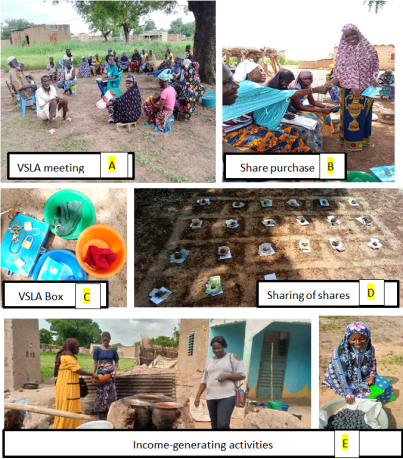
Figure 5. Illustrative photos of how VSLAs work.

Caption: A) VSLA meeting in progress; B) A member buying a share; C) VSLA equipment; D) Sharing the money at the end of the cycle; E) VSLA members conducting their income generating activities (preparing and selling “ dolo and soumbala”)
3.5. Impacts of Village Savings and Loan Associations on Improving Resilience
The resilience scores of households belonging to VSLAs groups show significantly higher scores compared to households not belonging to VSLAs groups (
Table 5). In the social and institutional domain, the difference of resilience score between VSLA members and non-members is not significant. In the economic sphere, the difference of resilience scores for sources of income/expenditure and savings are average for both VSLAs and non- VSLAs members and significant (p < 0.01). In the agronomic domain, resilience score for crop production is average for both VSLAs and non-VSLAs with significant difference (p < 0.05). In the environmental domain, the disturbance resilience score is low and significant between VSLAs members and non- VSLAs members (p < 0.01). Resilience scores for land management and tree planting resilience score is high for both VSLAs and non-VSLAs with significant difference (p < 0.001). VSLAs members have better knowledge of good agricultural production practices and are better able to manage the environment and adapt to climate change than non-members.
Table 5. Resilience score of members and non-members VSLAs by domain.
| Variables | Non VSLAs (n = 105) | VSLAs (n = 105) | F | P-value |
SOCIAL | SO_HH_RES- HOUSEHOLD | 12.6 a±2 | 12.6 a±2 | 0.107 | - |
SO_group_res- GROUP MEMBERSHIP | 5.4 a± 4.3 | 6.5 a±4.3 | 3.056 | - |
SO_coop_res- COMMUNITY COOPERATION | 13.4 a± 2.7 | 13.6 a± 2.7 | 0.006 | - |
SO_dmhh_res- HOUSEHOLD DECISION-MAKING | 11.6 a± 2.3 | 11.4 a± 2.3 | 0.257 | - |
SO_meal_res-ALIMENTATION | 10.9 a± 3.5 | 10.8 a± 3.5 | 0.112 | - |
AGRONOMIC | EN_crop_res-CROP PRODUCTION | 9b± 3.3 | 10.1 a± 3.3 | 5.672 | * |
SO_agr_res- AGRICULTURAL PRODUCTION ACTIVITIES | 8.1 a±3.5 | 9a±3.5 | 3.146 | - |
EN_animal_res- ANIMAL PRODUCTION PRACTICES | 10.6 a± 2.4 | 11.3 a±2.4 | 3.696 | - |
SO_landac_res- ACCESS TO LAND | 10.7a± 2.4 | 10,7 a± 2.4 | 0.886 | - |
SO_infoac_res- ACCESS WEATHER INFO AND ADAPT CC | 9 a±3.8 | 9.4 a±3.8 | 0.656 | - |
SO_ict_res- INFORMATION & COMMUNICATION TECHNOLOGY | 15.9 a± 1.8 | 15.7 a± 1,8 | 0.505 | - |
ECONOMICAL | EC_input_res-AGRICULTURAL INPUT | 10.2 a±3.3 | 10.6 a±3.3 | 0.794 | - |
EC_mkt_res- MARKETS ACCESS | 10.3 a±2 | 10.8 a±2 | 0.843 | - |
EC_inc_res- SOURCES OF INCOME/EXPENSES/SAVINGS | 9.7 b±3 | 10.9 a±3 | 8.288 | ** |
EC_ass_res- MAIN MEANS OF PRODUCTION | 12 a±3.4 | 12.4 a± 3.4 | 0.6 | - |
EC_fin_res- ACCESS TO FINANCIAL SERVICES | 13.7 a± 1.6 | 12.6 a± 1.6 | 2.758 | - |
EC_ins_res- INSURANCE | 17.5 a± 1.3 | 16.3 a± 1.3 | 1 | - |
ENVIRONNMENTAL INSTITUTIONNAL | EN_slm_res LAND MANAGEMENT | 14.8 b± 2,6 | 16 a±2.6 | 12.716 | *** |
EN_wacc_res WATER ACCESS AND MANAGEMENT | 12.4 a±1.4 | 12.4 a±1.4 | 0.031 | - |
EN_trees_res TREES | 11.5 b± 1.8 | 12.4 a± 1.8 | 13.509 | *** |
EN_cc_res DISTURBANCE | 3.9 b±3.1 | 5.1 a±3.1 | 7.852 | ** |
GO_gov_res_ GOVERNANCE | 14.5 a± 2.3 | 14.4 a± 2.3 | 0.019 | - |
-: not significant; * p < 0.05; **: p < 0,01; ***: p < 0,00
4. Discussion
4.1. VSLA Functionality and Sustainability
As of September 2024, 326 VSLAs have been established in the Central West from 2016 to 2024. The large number of VSLAs can be explained by the efforts of some VSLAs that have formed new VSLAs thanks to the new skills acquired. In addition, the improvement in the living conditions of VSLAs members is an additional source of motivation for the establishment of new VSLAs. A massive diffusion of VSLAs has been highlighted in the department of Ziguinchor in view of their importance for the community
| [17] | Fall K. Organization and Dynamics of Solidarity in Rural Areas: The Example of Village Savings and Credit Associations (VSLAs), Scientific Journal of the Alassane Ouattara University. 2021. Vol. 1 -. 40 p. |
[17]
. First-generation VSLAs (58.54%) were more likely to adhere to the maximum 3-month loan repayment period than second-generation VSLAs (24.39%) (χ² = 11.917 and p < 0.001). Members adapt the association model to the local context and circumvent regulations established to prevent embezzlement and anticipate potential conflicts
| [17] | Fall K. Organization and Dynamics of Solidarity in Rural Areas: The Example of Village Savings and Credit Associations (VSLAs), Scientific Journal of the Alassane Ouattara University. 2021. Vol. 1 -. 40 p. |
[17]
. Transparency in the operation of Village Savings and Loan Associations (VSLAs) summarizes one of their advantages
| [13] | CARE. Micro-savings: a development tool for populations excluded from microfinance., 2013, 13 p. |
[13]
. Regarding equipment, 91.3% of first-generation of VSLAs use three different colored drawstring bags, compared to 78.57% of second-generation of VSLAs. First-generation of VSLAs benefited from account books provided by organizations. However, second-generation of VSLAs imitate the use of account books by making similar ones or using local notebooks or equipment. The GEF project trained beneficiaries on the VSLA approach and facilitators on how to run VSLA groups. The project also provided all the VSLA groups with supplies to facilitate their operation, in addition to ongoing support.
The main strengths of VSLAs are solidarity (75.6%), social cohesion (68.3%), savings (51.2%) and access to credit (29.3%). These strengths can be explained by the fact that VSLAs share values such as love, understanding, respect, and trust. Trust is also one of the conditions for membership
| [13] | CARE. Micro-savings: a development tool for populations excluded from microfinance., 2013, 13 p. |
[13]
. The composition of VSLAs members and the selection criteria constitute the most important factor in the success and sustainability of VSLAs
| [18] | Champchesnel M. F., Fioekou C., Sanda H B., Lavaur A-L, Mayans J. Village Savings and Credit Associations: an approach adapted to the poorest households? Characteristics of members and impact on household economies. Clichy France, 2016, 36 p. |
[18]
. In terms of weaknesses, we mainly note insufficient income to purchase shares (48.8%), the absence of certain members at meetings (31.7%). The absence of a member of the board would make it difficult to hold a meeting. A lack of follow-up makes the sustainability of VSLAs uncertain
| [18] | Champchesnel M. F., Fioekou C., Sanda H B., Lavaur A-L, Mayans J. Village Savings and Credit Associations: an approach adapted to the poorest households? Characteristics of members and impact on household economies. Clichy France, 2016, 36 p. |
[18]
.
To ensure the sustainability of the project's results, the Coordination Unit developed a participatory approach involving all stakeholders. This translated into capacity building through training and empowerment in setting up and facilitating the Village Savings and Loan Associations (VSLAs). The mobilization of local savings and the development of income-generating activities (IGAs) have fostered member mobilization and ensured the sustainability of the groups
| [27] | Kouadio Sarah. Village savings and credit associations and empowerment: a socio-economic analysis, 2020, 16 p. |
[27]
. VSLAs offer opportunities for access to credit (73.2%) and the development of income-generating activities (22%) in rural areas¸ More than 96% of women members of VSLAs have access to credit that allows them to develop income-generating activities
| [14] | Kaire A.K., Sow S. et Balde S. The effects of microcredit on strengthening the socioeconomic power of women members of the Village Savings and Credit Associations (VSLAs) of the Commune of Sahm Notary. Int. J. Econ. Stud. Manag. 2022, 2, No. 3. 473-488 https://doi.org/10.5281/zenodo.6913827. |
[14]
. The level of experience in associations is linked to seniority and therefore this seniority contributes to the process of community development
| [16] | Ndabarushimana A. & Niyokwizzera E. Role of Save Our Souls (SOS) Children's Villages Burundi in the Community Development Process: The Case of Village Savings and Loan Associations (VSLAs) Initiated by its Program for Improving the Living Conditions of Households in Bujumbura. ESI Preprints, 2022, 339 p. https://doi.org/10.19044/esipreprint.10.2022 |
[16]
. However, insecurity and the evolving regulations governing financial activities remain challenges for the sustainability of VSLAs.
4.2. Pathways to Resilience
Globally, the Framework Convention on Climate Change considers the mobilization of financial resources and the transfer of technologies essential to addressing climate change
| [28] | United Nations Framework Convention on Climate Change (UNFCCC). Contribution to the World Summit on Sustainable Development, Conference of the Parties, Seventh Session, Marrakech, 2001, 10 p. |
[28]
. In Burkina Faso, various forms of savings mobilization exist within the formal and informal systems
| [12] | National Institute of Statistics and Demography (NISD). Multi-sectoral survey: Savings and access to credit, 2015, 73 p. |
[12]
. At the informal level, there are, among others, rotating savings and credit associations (ROSCAs), cumulative savings and credit associations (CSAs), gold mining schemes, and village savings and credit associations (VSLAs) or internal savings and credit communities (ICCCs). VSLAs are gaining momentum to address climate change. They serve not only as a financial tool but also as a means of adaptation and resilience for rural households. VSLAs lead to higher resilience through credit (economic pathway), social cohesion (social capital pathway) and shared knowledge (environmental practice pathway). Their aim is to consolidate solidarity, social cohesion and the financial autonomy of members, thereby increasing the capacity of the system or household to recover, reorganize, and evolve after experiencing external stresses and disturbances
| [19] | Choptiany J., Graub B., Phillips S., Colozza D. & Dixon J. Self-evaluation and holistic assessment of climate resilience of farmers and pastoralists. Rome, FAO, 2015.
http://www.fao.org/3/i4495e/i4495e.pdf (accessed 20 October 2025). |
[19]
. Savings are redirected in the form of credit towards resource-creating activities. In the economic sphere, the resilience scores for the sources of income/expenditure and savings is average for both VSLAs and non- VSLAs members (10.9a ± 3 for VSLAs members and 9.7b ± 3 for non-VSLAs members). This difference is significant (F = 8.288; p < 0.01) and could be explained by the fact that VSLAs members who are heads of household have financial access that allows them to engage in income-generating activities (IGAs). They use the income from these IGAs, which they invest in supporting their households.
In the environmental domain, resilience scores for crop production, pest management, and livestock production practices are average for both VSLAs and non-VSLAs members. The difference is more pronounced for the crop production score between VSLAs members (10.1a ± 3.3) and non-members (9b ± 3.3; F = 5.672; p < 0.05). Resilience scores for land management is high for both VSLAs and non-VSLAs members, with an upward trend for VSLAs members (VSLAs = 16a ± 2.6 and not VSLAs = 14.8b ± 2.6; F = 12.716 and p < 0.001). This same trend is observed in the tree planting resilience score, which is average for non-VSLAs members (11.5b ± 1.8) and high for VSLAs members (12.4a ± 1.8), with a significant difference (F = 13.509, p < 0.001). VSLAs members have better knowledge of good agricultural production practices and are better able to manage the environment and adapt to climate change than non-members.
4.3. Gender Dynamics
VSLA is a good learning channel in group management, decision-making, leadership, access to and management of credit, micro-enterprise management (AGR), but also lobbying
| [27] | Kouadio Sarah. Village savings and credit associations and empowerment: a socio-economic analysis, 2020, 16 p. |
[27]
.
The first-generation of VSLAs were more often led by men (39.02%) and second-generation of VSLAs by women (29.27%) (χ² = 5.528 and p < 0.05). In rural areas, male leaders are more willing to coordinate development actions. With the support provided to first-generation of Village Savings and Loan Associations (VSLAs) by the GEF project, men hoped for additional benefits beyond simply mobilizing savings. However, women are more patient and diligent in attending VSLA’s meetings. VSLAs women members use credit for their income-generating activities and reserve a portion for food, education, and healthcare expenses
| [14] | Kaire A.K., Sow S. et Balde S. The effects of microcredit on strengthening the socioeconomic power of women members of the Village Savings and Credit Associations (VSLAs) of the Commune of Sahm Notary. Int. J. Econ. Stud. Manag. 2022, 2, No. 3. 473-488 https://doi.org/10.5281/zenodo.6913827. |
[14]
. Income-generating activities (IGAs) are a profitable investment that allows women to have more money to take care of the household
| [16] | Ndabarushimana A. & Niyokwizzera E. Role of Save Our Souls (SOS) Children's Villages Burundi in the Community Development Process: The Case of Village Savings and Loan Associations (VSLAs) Initiated by its Program for Improving the Living Conditions of Households in Bujumbura. ESI Preprints, 2022, 339 p. https://doi.org/10.19044/esipreprint.10.2022 |
[16]
. Women increase their empowerment through the activities they develop in Village Savings and Loan Associations (VSLAs) and also use savings for unexpected expenses and to become less dependent on their husbands
| [15] | Eclosio. Village Savings and Credit Associations (VSLAs): A tool for strengthening the economic empowerment of Beninese women farmers. ANAF-Benin, 2016, 3 p. |
[15]
. Cultural norms would suggest that this would usually be the husband's preferences, which might be another reason for most VSLA members being women
| [29] | Christopher Ksoll, Helene Bie Lilleør, Jonas Helth Lønborg, Ole Dahl Rasmussen. Impact of Village Savings and Loan Associations: Evidence from a cluster randomized trial. Journal of Development Economics 120 (2016) 70–85. |
[29]
. Within Village Savings and Loan Associations (VSLAs), women acquire leadership skills that allow them to take initiatives both within the group and in their household lives. VSLAs are emerging as an effective solution for enabling women to sustainably improve their living conditions
.
5. Limitations
The study concluded with interesting results regarding the impact of Village Savings and Loan Associations (VSLAs) on improving the resilience of vulnerable populations. However, these results may be limited by the fact that data collection was sporadic rather than long-term, and limited to a small number of villages in only one of the four regions where the GEF project was implemented.
6. Conclusions and Recommendations
This study provides strong evidence that community-based financial groups like VSLAs can be an effective tool for enhancing climate resilience among smallholder farmers. Village Savings and Loan Associations (VSLAs) facilitate access to credit and strengthen social cohesion. This study reveals that the number of VSLAs increased after the FAO's GEF project in the Centre-West region. They mobilize significant savings at the local level. Their main strengths are solidarity, social cohesion, savings, and access to credit. First-generation VSLAs adhere to operating rules more closely than second-generation VSLAs. The climate change resilience scores of Village Savings and Loan Associations (VSLAs) members are higher than those of non-VSLA members. Given the socio-economic and environmental importance of VSLAs, it is crucial to facilitate their connection with microfinance institutions to enhance sustainability and support income-generating activities for agricultural enterprises. Formal financial institution partnerships can help to mitigate insecurity risk of savings and need for larger loans. In addition continual capacity building mainly for 2nd generation VSLAs on record-keeping and governance and VSLA facilitators on SHARP tool and the supporting the formalization of VSLAs are needed to reach out VSLA standards. VSLAs must continue their technical activities in farmer field school and received climate information services and agricultural extension to reinforce the environmental resilience gains. In perspective longitudinal studies to track long-term impacts and causality is envisaged.
Abbreviations
ANAM-BF | National Agency of Meteorology |
ANOVA | Analysis of Variance |
CdR | Resilience Fund |
CoBRA | Community Resilience Assessment and Action |
FAO | Food and Agriculture Organization of the United Nations |
GDP | Gross Domestic Product |
GEF | Global Environment Facility |
HDI | Human Development Index |
IGAs | Income-Generating Activities |
INSD | National Institute of Statistic and Demography |
NGOs | Non-Governmental Organizations |
ODK | Open Data Kit |
REAL | Resilience Evaluation, Analysis and Learning |
RIMA | Resilience Index Measurement and Analysis |
SHARP | Holistic Scheme for Self-Assessment of Climate Resilience |
UN | United Nations Agencies |
UNDP | United Nation Development Programme |
VSLA | Village Savings and Loan Associations |
Acknowledgments
The authors thank all the populations at the study sites, the technical services, non-governmental organizations, and the agencies of the United Nations system for their collaboration during data collection. We especially thank the Food and Agriculture Organization of the United Nations (FAO), a pioneer in the establishment of Village Savings and Loan Associations (VSLAs) in Burkina Faso and Laboratory for Rural Studies on Environment, Economic and Social Development team.
Author Contributions
Mahamoudou Koutou: Conceptualization, Data curation, Formal Analysis, Methodology, Resources, Writing – original draft
Boundia Alexandre Thiombiano: Supervision, Validation, Writing – review & editing
Souleymane Karambiri: Validation, Writing – review & editing
Salamata Souli: Data curation, Investigation, Writing – review & editing
Stephane Ilboudo: Conceptualization, Visualization, Validation
Kossi Sena Adufu: Validation, Writing – review & editing
Patrice Toe: Supervision, Validation
Funding
This work is not supported by any external funding.
Data Availability Statement
The data supporting the outcome of this research work has been reported in this manuscript.
Conflicts of Interest
The authors declare no conflicts of interest.
References
| [1] |
IPCC. Climate Change: Synthesis Report. Contribution of Working Groups I, II and III to the Sixth Assessment Report of the Intergovernmental Panel on Climate Change [Core Writing Team, H. Lee and J. Romero (eds.)]. IPCC, 2023, Geneva, Switzerland, 184 pp.,
https://doi.org/10.59327/IPCC/AR6-9789291691647
|
| [2] |
Roncoli C, Ingram K, Kirshen P. «the costs and risks of coping with drought: livelihood impact and farmers’ responses in Burkina Faso», In Climate research, 19, 2001, pp. 119-132.
|
| [3] |
Brou Y T., Akindes F., Bigot S. «Climate variability in Côte d'Ivoire: social perceptions and agricultural responses», In Cahiers Agricultures. 2005, 14(6): 533-540.
https://doi.org/10.13140/2.1.5174.3368
|
| [4] |
Ministry of Economy, Finance and Forecasting (MEFP). National accounts for 2023 (First estimates based on the CNTs), 2023, 11 p.
|
| [5] |
PNSR II. Second National Rural Sector Programme (PNSR), 2017, 70 p.
|
| [6] |
CONASUR. National multi-hazard plan for disaster preparedness and response, 2012, Available from:
https://www.preventionweb.net/publication/burkina-faso-plan-nationalmulti-risques-de-preparation-et-de-reponse-aux-catastrophes
(accessed 20 October 2025).
|
| [7] |
Sidibe H, Diallo M et Barry C. «Pulaaku and identity crisis: the case of the Red Fulani of the Issa-Ber lake region in Mali» In Fulani identity; Paris, Karthala, 1997, pp. 223-240.
|
| [8] |
Soulama A. Floods in Burkina Faso in early September, 2009. Available from:
https://www.mediaterre.org/afrique_ouest/actu.html
(accessed 22 August 2025).
|
| [9] |
National Meteorological Agency (ANAM-BF). Ten-day agro-meteorological bulletin n 28, 2022, 11 p.
|
| [10] |
United Nations Development Programme (UNDP). Human Development Report, 2022, 8 p.
|
| [11] |
Ministry of the Economy, Finance and Forecasting (MEFF). Main findings of the study on poverty and household living conditions, 2021, 8 p.
|
| [12] |
National Institute of Statistics and Demography (NISD). Multi-sectoral survey: Savings and access to credit, 2015, 73 p.
|
| [13] |
CARE. Micro-savings: a development tool for populations excluded from microfinance., 2013, 13 p.
|
| [14] |
Kaire A.K., Sow S. et Balde S. The effects of microcredit on strengthening the socioeconomic power of women members of the Village Savings and Credit Associations (VSLAs) of the Commune of Sahm Notary. Int. J. Econ. Stud. Manag. 2022, 2, No. 3. 473-488
https://doi.org/10.5281/zenodo.6913827.
|
| [15] |
Eclosio. Village Savings and Credit Associations (VSLAs): A tool for strengthening the economic empowerment of Beninese women farmers. ANAF-Benin, 2016, 3 p.
|
| [16] |
Ndabarushimana A. & Niyokwizzera E. Role of Save Our Souls (SOS) Children's Villages Burundi in the Community Development Process: The Case of Village Savings and Loan Associations (VSLAs) Initiated by its Program for Improving the Living Conditions of Households in Bujumbura. ESI Preprints, 2022, 339 p.
https://doi.org/10.19044/esipreprint.10.2022
|
| [17] |
Fall K. Organization and Dynamics of Solidarity in Rural Areas: The Example of Village Savings and Credit Associations (VSLAs), Scientific Journal of the Alassane Ouattara University. 2021. Vol. 1 -. 40 p.
|
| [18] |
Champchesnel M. F., Fioekou C., Sanda H B., Lavaur A-L, Mayans J. Village Savings and Credit Associations: an approach adapted to the poorest households? Characteristics of members and impact on household economies. Clichy France, 2016, 36 p.
|
| [19] |
Choptiany J., Graub B., Phillips S., Colozza D. & Dixon J. Self-evaluation and holistic assessment of climate resilience of farmers and pastoralists. Rome, FAO, 2015.
http://www.fao.org/3/i4495e/i4495e.pdf
(accessed 20 October 2025).
|
| [20] |
RGPH. Monograph of the Central-Western Region, 2019, 181 p.
|
| [21] |
Central West Regional Development Plan, 2017-2021, 2017, 169 p.
|
| [22] |
Coordination Sud. Adaptation and resilience to climate change: Review of metrics and monitoring indicators, 2022, 43 p.
|
| [23] |
Lagana H, M., Phillips, S. and Poisot, A. Self-evaluation and holistic assessment of climate resilience of farmers and pastoralists (sharp+) – A new guidance document for practitioners. Rome, FAO. 2022.
https://doi.org/10.4060/cb7399en
|
| [24] |
Carpenter S., Walker B., Anderies J. M. & Abel N. From metaphor to measurement: Resilience of what to what? Ecosystems. 2001, 4(8): 765–781,
https://doi.org/10.1007/s10021-001-0045-9
|
| [25] |
Walker B., Holling C. S., Carpenter S. R. & Kinzig A. Resilience, adaptability and transformability in social-ecological systems. Ecology and Society. 2004, 9(2): 5
http://www.ecologyandsociety.org/vol9/iss2/art5/
|
| [26] |
Cabell, J. F., and M. Oelofse. An indicator framework for assessing agroecosystem resilience. Ecology and Society. 2012, 17(1): 18.
http://dx.doi.org/10.5751/ES-04666-170118
|
| [27] |
Kouadio Sarah. Village savings and credit associations and empowerment: a socio-economic analysis, 2020, 16 p.
|
| [28] |
United Nations Framework Convention on Climate Change (UNFCCC). Contribution to the World Summit on Sustainable Development, Conference of the Parties, Seventh Session, Marrakech, 2001, 10 p.
|
| [29] |
Christopher Ksoll, Helene Bie Lilleør, Jonas Helth Lønborg, Ole Dahl Rasmussen. Impact of Village Savings and Loan Associations: Evidence from a cluster randomized trial. Journal of Development Economics 120 (2016) 70–85.
|
| [30] |
Agrifarm. Village Savings and Loan Associations (VSLAs): An essential lever for women's empowerment in Africa, 2015,
https://agrifambenin.wordpress.com/2025/03/15/c
accessed on february, 10th, 2026.
|
Cite This Article
-
APA Style
Koutou, M., Thiombiano, B. A., Karambiri, S., Souli, S., Ilboudo, S., et al. (2026). Impact of Village Savings and Loan Associations on Improving the Resilience of Vulnerable Populations to Climate Change in the Central West Region of Burkina Faso. International Journal of Agricultural Economics, 11(2), 29-43. https://doi.org/10.11648/j.ijae.20261102.11
Copy
|
Download
ACS Style
Koutou, M.; Thiombiano, B. A.; Karambiri, S.; Souli, S.; Ilboudo, S., et al. Impact of Village Savings and Loan Associations on Improving the Resilience of Vulnerable Populations to Climate Change in the Central West Region of Burkina Faso. Int. J. Agric. Econ. 2026, 11(2), 29-43. doi: 10.11648/j.ijae.20261102.11
Copy
|
Download
AMA Style
Koutou M, Thiombiano BA, Karambiri S, Souli S, Ilboudo S, et al. Impact of Village Savings and Loan Associations on Improving the Resilience of Vulnerable Populations to Climate Change in the Central West Region of Burkina Faso. Int J Agric Econ. 2026;11(2):29-43. doi: 10.11648/j.ijae.20261102.11
Copy
|
Download
-
@article{10.11648/j.ijae.20261102.11,
author = {Mahamoudou Koutou and Boundia Alexandre Thiombiano and Souleymane Karambiri and Salamata Souli and Stephane Ilboudo and Kossi Sena Adufu and Patrice Toe},
title = {Impact of Village Savings and Loan Associations on Improving the Resilience of Vulnerable Populations to Climate Change in the Central West Region of Burkina Faso},
journal = {International Journal of Agricultural Economics},
volume = {11},
number = {2},
pages = {29-43},
doi = {10.11648/j.ijae.20261102.11},
url = {https://doi.org/10.11648/j.ijae.20261102.11},
eprint = {https://article.sciencepublishinggroup.com/pdf/10.11648.j.ijae.20261102.11},
abstract = {Climate change negatively affects the production systems and producer’s incomes. This study assesses the impact of Village Savings and Loan Associations (VSLA) on strengthening the resilience of vulnerable populations to climate change. Data were collected through focus groups with 41 VSLA and a survey of 210 households VSLA members and non-members, using Holistic Self-Assessment of Peasant Resilience tool. Analysis of variance was applied to the data. The Newman-Keuls test at 5% threshold was used to compare resilience scores, and the chi-square test was applied. The number of VSLA is increasing in Central West region of Burkina Faso. The VSLA of first generation mobilized a yearly average of 1 522 401 F CFA and gave 895 941 F CFA of credits. Their main strengths are solidarity, social cohesion, collect of savings and credit access. VSLA members showed significantly higher resilience scores across social, economic, and environmental domains, particularly in income diversification (p<0.01), land management (p<0.001), and reforestation practices (p<0.001). VSLA contributes significantly to improve social, economic and environmental resilience scores for the vulnerable communities. For the successful operation of VSLA, it’s important to establish partnerships with financial institutions to promote financial inclusion and strengthen actors capacities for more impacts.},
year = {2026}
}
Copy
|
Download
-
TY - JOUR
T1 - Impact of Village Savings and Loan Associations on Improving the Resilience of Vulnerable Populations to Climate Change in the Central West Region of Burkina Faso
AU - Mahamoudou Koutou
AU - Boundia Alexandre Thiombiano
AU - Souleymane Karambiri
AU - Salamata Souli
AU - Stephane Ilboudo
AU - Kossi Sena Adufu
AU - Patrice Toe
Y1 - 2026/03/16
PY - 2026
N1 - https://doi.org/10.11648/j.ijae.20261102.11
DO - 10.11648/j.ijae.20261102.11
T2 - International Journal of Agricultural Economics
JF - International Journal of Agricultural Economics
JO - International Journal of Agricultural Economics
SP - 29
EP - 43
PB - Science Publishing Group
SN - 2575-3843
UR - https://doi.org/10.11648/j.ijae.20261102.11
AB - Climate change negatively affects the production systems and producer’s incomes. This study assesses the impact of Village Savings and Loan Associations (VSLA) on strengthening the resilience of vulnerable populations to climate change. Data were collected through focus groups with 41 VSLA and a survey of 210 households VSLA members and non-members, using Holistic Self-Assessment of Peasant Resilience tool. Analysis of variance was applied to the data. The Newman-Keuls test at 5% threshold was used to compare resilience scores, and the chi-square test was applied. The number of VSLA is increasing in Central West region of Burkina Faso. The VSLA of first generation mobilized a yearly average of 1 522 401 F CFA and gave 895 941 F CFA of credits. Their main strengths are solidarity, social cohesion, collect of savings and credit access. VSLA members showed significantly higher resilience scores across social, economic, and environmental domains, particularly in income diversification (p<0.01), land management (p<0.001), and reforestation practices (p<0.001). VSLA contributes significantly to improve social, economic and environmental resilience scores for the vulnerable communities. For the successful operation of VSLA, it’s important to establish partnerships with financial institutions to promote financial inclusion and strengthen actors capacities for more impacts.
VL - 11
IS - 2
ER -
Copy
|
Download